|
Barn
Pastures
About ten acres of land surrounding the sheep barn
has been subdivided into numerous smaller paddocks,
where the sheep spend the winter and early spring.
These
pastures used to be hayfield but now, thanks to the
miraculous fertilizer called sheep manure, they are
some of the farm's richest grazing areas. They
never receive any chemical fertilizer, herbicide,
or pesticide.
The
lambs are born in these pastures, and they thrive
on the high quality milk their moms produce while
grazing here.
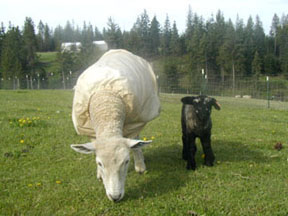
Right,
Audrey and her newborn lamb in the upper barn
pasture, Spring 2002.
|
|
|
|
Woods Pastures
The pastures where the ewes and lambs spend most of
their summers consist of about 30 acres of mixed
grassy woodland. This part of the farm used to be
heavily wooded, but it was selectively logged in
1998, and now grows a great crop of mixed grasses
in a semi-shaded setting.
No
chemical fertilizers, herbicides, or pesticides are
applied to this ground, just nature's own best
fertilizer. Intensive rotational grazing every
summer is dramatically improving the quality and
quantity of forage in these pastures. SkyLines
lambs put on most of their growth in these areas,
grazing with the ewes through each subdivided
pasture two or three times over the course of the
summer.
|
|
Hayfield Grazing
SkyLines sheep graze the farm's 21-acre hayfield
for a few weeks every year, during the spring and
fall. During the summer, the sheep are fenced out,
while the field grows a nutritious mixed grass hay
that the sheep thrive on all winter long.
Herbicides
No herbicides are applied to the hayfield. Weeds
that appear in any quantity are cut by hand before
they can go to seed and before the hay is cut and
baled.
Pesticides
A mixed-grass stand of hay in this part of the
country isn't subject to any significant insect
damage, so pesticides really aren't an issue,
fortunately. Of course, the innumerable mice,
voles, and pocket gophers that thrive in the
hayfield and pastures are pests as far as I'm
concerned, but I just send good vibes to the
kestrels, hawks, and owls that hang out in the
area.
Fertilizer
The hayfield on this farm has been chemically
fertilized for many, many years, and had always
produced a great crop of hay. In spring of '02,
however, I was impatient to start my organic
approach to hay farming and decided not to
fertilize the hayfield that season. I thought the
natural fertilizer put down by four years of
grazing sheep in the hayfield's off-season would be
adequate. Well, live and learn.
Though
the hay crop in August was still large enough to
feed the SkyLines flock for the following winter,
the hay volume from that field dropped
dramatically, to HALF of its former levels. That
field had become totally dependant on its annual
"chemical fix" to grow its hay crop, and it wasn't
about to recover in just four short seasons of
grazing sheep on the stubble!
I'd
read about many farmers who struggled with a
dramatic drop in production while making the switch
to organic, but now I truly "get it." How many
farmers are willing to, or can afford to, cut their
production and/or income in half for a few years
while they implement organic farming methods and
wait for the soil to respond?
What
to do? Manure, of course, is the oldest and best
natural fertilizer, but I wasn't able to import
large quantities of manure from another farm, since
anyone who raises their animals organically
realizes that the manure is "brown gold" and isn't
about to part with it. And I certainly wouldn't use
manure from a non-organic farm, not knowing what
sort of chemical brew the animals had been fed. So,
I decided to fertilize the hayfield with nitrogen
and sulphur again. I will probably do so for quite
a few more years, as I continue to slowly improve
the fertility and tilth of the hayfield by
non-chemical means. One of these approaches is
applying Dolomitic lime, and of course grazing by
SkyLines sheep. My eventual goal is to discontinue
the use of chemical fertilizer completely.
In
the meantime, SkyLines sheep will continue to
happily graze the hayfield in spring and fall while
depositing their wonderful natural fertilizer, and
of course, herbicides and pesticides will continue
to be off-limits for any of the SkyLines
pastures.
|

